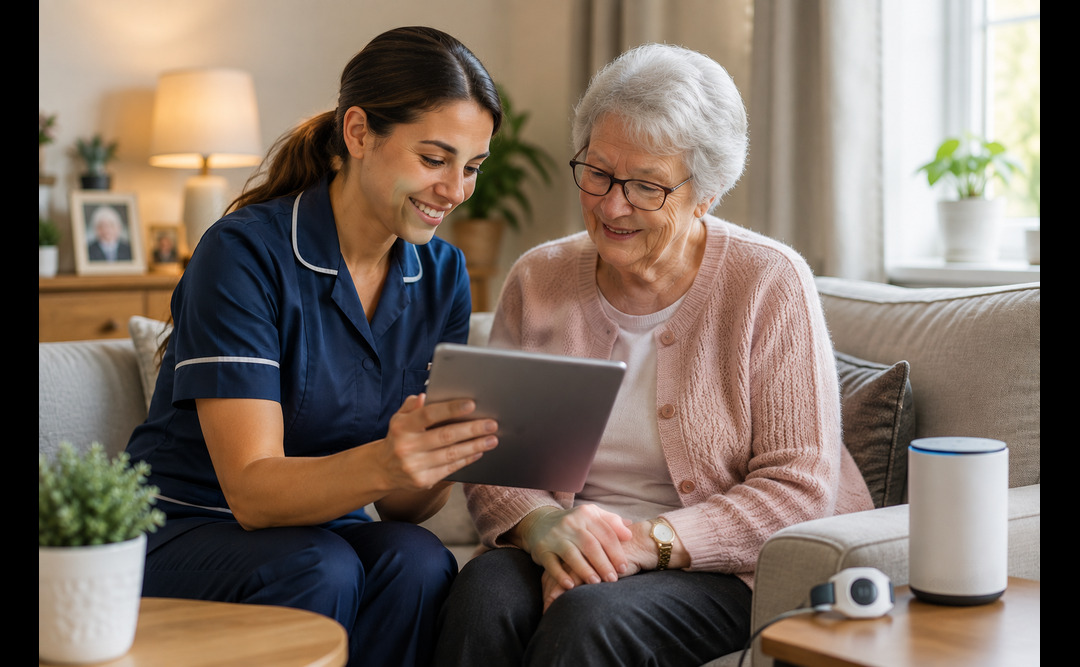
It's seven in the morning in Keighley, and Margaret, 82, is pouring her tea. Over in Manchester, her daughter checks an app on her phone and sees a small green tick: her mum's carer has just arrived, right on time. Ten years ago, that quiet reassurance simply didn't exist.
Home care in the UK has quietly gone through a technology revolution, and most families haven't clocked just how much has changed. From digital care plans that update the moment a visit ends, to wrist-worn alarms that call for help before anyone even realises something is wrong, technology is reshaping what home care services look like in practice.
This isn't about swapping a familiar, friendly face for a screen. It's about giving carers better tools, giving families genuine peace of mind, and helping older people stay independent at home for longer and more safely. In this article, we'll look at how technology is changing home care services across the UK, with real examples, honest tips, and a look at what's about to change for anyone using a telecare alarm.
Why Technology Matters in Home Care Services Right Now
The UK is getting older, and quickly. There are now around 12.7 million people aged 65 and over, close to one in five of the population, and that figure is expected to keep climbing for decades. In England alone, an estimated 4.2 million people aged 65 and over live on their own.
Most older people would rather stay in their own home than move anywhere else, and around 90% of people over 65 in the UK say exactly that. It's easy to understand why: familiar surroundings, a settled routine, and a life built over decades that nobody wants to leave behind.
But staying at home safely doesn't just happen on its own. More than one in three people over 65 fall at least once a year, and Age UK estimates that around 2 million older people currently have care needs that aren't being fully met. Add well documented staffing pressures across social care, and it's clear why home care providers have had to find smarter ways of working. Technology hasn't replaced good, hands-on care; it has given carers, families and the people they support tools that simply didn't exist a decade ago.

The number of people aged 65 and over in the UK has nearly doubled since 1972 and is projected to keep rising, increasing demand for home care services nationwide.
Key Technologies Transforming Home Care Services in the UK
Here's a closer look at the technologies actually shaping home care services across the UK today, and why each one matters.
Digital Care Plans and Electronic Records
Not long ago, a care plan was a paper folder kept in a hallway drawer, filled in by hand and easy to lose track of. Most home care services in the UK have now moved, or are moving, to secure digital social care records, which store care plans, risk assessments and daily notes online.
The practical difference is speed. If a carer notices someone seems unsteady on their feet during a morning visit, that note can be logged on a phone immediately, and the rest of the care team, and with permission the GP, can see it within hours rather than waiting for the next handover.
Electronic Call Monitoring and GPS Visit Verification
One of the most reassuring changes for families is electronic call monitoring. Carers check in and out of each visit using an app, which confirms their location using GPS, creating an accurate record of exactly when care was delivered.
If a carer hasn't checked in when expected, the office is alerted straight away rather than finding out hours later that a visit was missed. Some systems also give approved family members their own login, so a relative living some distance away can see that today's visit happened, and roughly what time.
Telecare, Wearables and Fall Detection
Given how common falls are among older people, telecare has become one of the most valuable technologies in home care. A wrist-worn or pendant alarm with automatic fall detection can sense a hard fall and raise the alert on its own, even if the wearer cannot press a button. Movement sensors placed around the home can also flag unusual inactivity, for example if someone hasn't got up by mid-morning as usual.
These devices connect to a 24-hour monitoring centre, which can call the person directly, contact a family member, or send help, often within minutes.
Smart Medication Management
Missed or incorrect medication is a genuinely serious problem. The NHS estimates that between 30% and 50% of medicines prescribed for long-term conditions are not taken exactly as intended, contributing to unnecessary hospital admissions and wasting an estimated £300 million of NHS resources every year.
Automatic pill dispensers help close that gap. They release the correct dose at the right time, sound an alarm or flash a light as a reminder, and can alert a family member if a dose is missed. One UK adult social care project found automatic dispensers saved an average of around £1,700 per person over six months, largely through fewer missed doses and fewer visits needed purely to supervise medication.
Video Calling and Smart Speakers for Companionship
Loneliness is a genuine health risk for older people living alone, not just an emotional one. Simple, large-button video calling devices and voice-controlled smart speakers, such as Amazon Alexa or Google Nest, have made staying connected much easier for people who might struggle with a smartphone.
A smart speaker can be set up to remind someone to drink water, take medication, or call a grandchild just by saying a name aloud, with nothing to dial or remember. For someone with limited mobility or early-stage dementia, that small bit of independence can make a real difference.
Artificial Intelligence in Care Planning
AI is arriving in home care faster than many families realise. A 2026 survey of UK home care providers found around seven in ten were already using or trialling AI tools, mostly to help write clearer care notes, flag patterns that suggest someone's needs are changing, or support more efficient scheduling.
It's worth being clear about what this does and doesn't mean. The Care Quality Commission's 2026 guidance on AI in health and social care is explicit that these tools exist to support carers, not replace their judgement. A trained carer or manager always remains in control of decisions about someone's care.
Home Care Technologies at a Glance
Here's a quick summary of how each technology helps:
Technology | What It Does | Key Benefit |
|---|---|---|
Digital care plans | Stores and shares care notes, plans and risk assessments securely online | Fewer errors and better teamwork between carers, GPs and family |
Electronic call monitoring | Confirms carer visit times and location using GPS | Faster response to missed or late visits |
Telecare and fall detection | Wearable alarms and home sensors linked to a monitoring centre | Faster help after a fall or emergency |
Smart medication dispensers | Dispenses medication and reminds at set times, alerting if a dose is missed | Fewer missed or incorrect doses |
Video calling and smart speakers | Voice-controlled calls, reminders and entertainment | Reduces loneliness and isolation |
AI-assisted care planning | Supports note writing and helps spot changes in someone's needs | More time for hands-on, person-centred care |
Real Benefits Families Actually Notice
Strip away the jargon, and the benefits of all this technology come down to a few simple things families genuinely notice.
Independence lasts longer: people can stay in the home they know, surrounded by their own things, rather than moving into residential care sooner than they need to.
Families worry less: knowing a visit happened, medication was taken, or help is a button press away removes a lot of quiet anxiety from caring for someone at a distance.
Help arrives faster: whether it's a fall detector or a missed-visit alert, technology shrinks the gap between something going wrong and someone finding out.
Everyone stays better informed: carers, GPs, hospital teams and family members work from the same up-to-date picture, instead of piecing things together after the fact.
What's Changing in 2026 and 2027: The Telecare Switchover
The Digital Switchover Deadline
Here's something every family using a personal alarm or pendant needs to know. The UK's old analogue telephone network, known as the PSTN, is being switched off completely by 31 January 2027. Any telecare alarm that still relies on a traditional landline connection may stop working once a local telephone exchange makes the switch, sometimes with very little warning.
Quick check: Contact your telecare provider today and ask whether your alarm already works over a digital or mobile connection. If it doesn't, arrange an upgrade well before the deadline, rather than waiting until it stops working. |
The good news is that most reputable providers are already migrating customers to digital-ready alarms, and many newer devices are unaffected. If a device hasn't been checked in the last few years, though, now is the time to ask.
Practical Tips for Choosing the Right Home Care Technology
Choosing the right technology can feel overwhelming, so here are a few grounded, practical tips.
Start with the actual problem, not the gadget. If falls are the main worry, prioritise fall detection first. If it's medication, start there instead.
Ask what's already included. Many home care services now build electronic call monitoring and digital care plans into standard practice at no extra charge.
Check it's ready for 2027. Before buying or renewing a telecare alarm, confirm it works over a digital connection rather than an analogue phone line.
Involve your loved one in the decision. A device someone is comfortable wearing and willing to use daily is worth more than extra features left unused in a drawer.
Ask about data protection. A reputable provider should explain clearly how visit records and health information are stored, and who can access them.
Treat technology as a support, not a substitute. The best results come from combining it with regular, genuine human contact, not replacing one with the other.
How Elmar Home Care Blends Technology with Compassionate Care
Elmar Home Care has been supporting families across Keighley, Leeds, Bradford and Greater Manchester since 1986, and one thing hasn't changed in all that time: care built around the person, not the paperwork.
What has changed is how that care is delivered day to day. As a CQC-registered provider, Elmar Home Care has steadily introduced new technology and training alongside its personal care, companion care, live-in care, respite care, and specialist dementia and Alzheimer's care services, always with the same aim: giving carers better tools so they can spend more time actually caring, and less time on paperwork.
Technology, in other words, sits quietly in the background. The carer who sits with you for a cup of tea, helps with breakfast, or simply checks in for a chat remains the heart of the service. If you would like to talk through what a home care package could look like for you or someone you love, Elmar Home Care's team is happy to have that conversation, with no obligation, just honest advice.
Frequently Asked Questions
Will technology replace my carer?
No. Every piece of technology mentioned here, from digital care plans to AI-assisted note writing, is designed to support carers, not replace them. Decisions about care always remain with trained carers and care managers, never with software alone.
Do I have to pay extra for things like electronic call monitoring?
Usually not. Most established home care providers now build electronic call monitoring and digital care plans into their standard service, so it's worth asking directly rather than assuming there's an added cost.
What happens to my telecare alarm when analogue phone lines are switched off?
Older alarms relying on a traditional landline may stop working once your local exchange completes its move to digital, a process happening in phases ahead of the final deadline of 31 January 2027. Contact your telecare provider now to check whether your device needs upgrading.
Is my data safe when home care services use apps and digital records?
Reputable UK home care providers must meet strict data protection standards, including the Data Security and Protection Toolkit used across health and social care. Ask your provider to explain their data policy in plain terms.
How do I know if fall detection or medication technology is right for my relative?
A few signs are worth watching for: a recent fall or near miss, several medications taken at different times of day, living alone with limited nearby support, or early memory difficulties. Any of these are good reasons to raise the subject with a home care provider.
Can family members see care visits happening in real time?
Often, yes. Many electronic call monitoring systems offer a family portal or app where approved relatives can see when a visit started and ended. It's worth asking your provider whether this feature is available.
Final Words
Technology hasn't changed why people choose home care services. Families still want their loved ones to be safe, comfortable and treated with dignity in the place they call home. What's changed is how reliably that can now be delivered: faster help after a fall, fewer missed medications, clearer communication, and far less guesswork for families supporting someone from a distance.
Used well, technology and compassionate, hands-on care aren't in competition. They work together, and that combination is exactly what makes home care services in the UK safer and more reassuring than ever before.
If you're weighing up home care options for yourself or someone in your family, contact us as Elmar Home Care would be glad to talk it through, with no pressure, just a straightforward conversation about what would actually help.