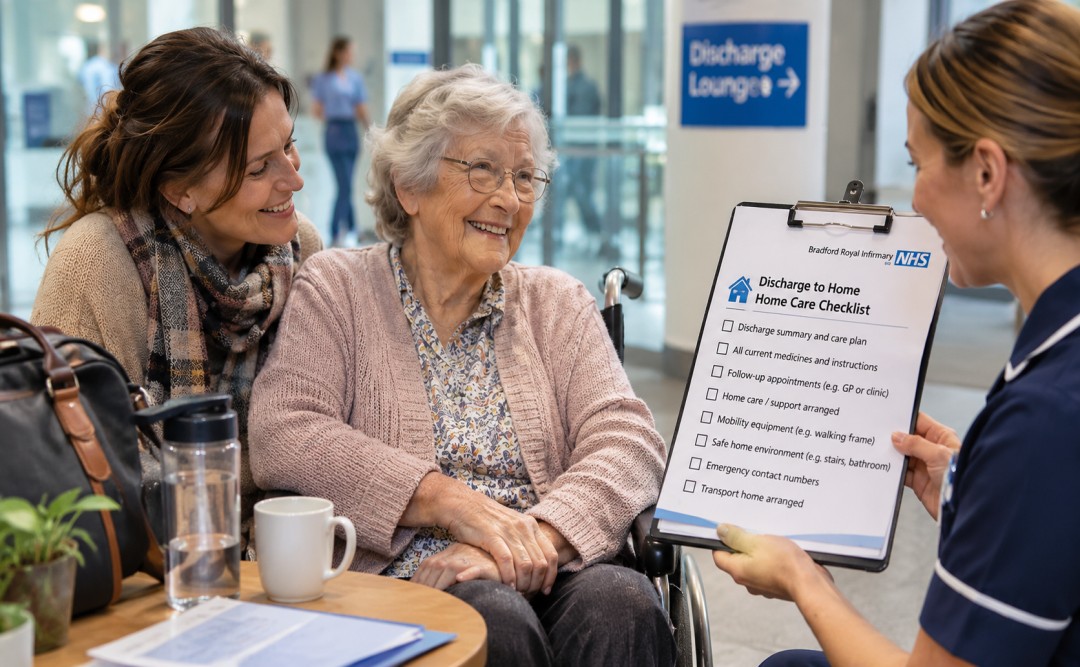
The nurse says you can go home tomorrow. You feel relieved, and then the questions arrive. Who is collecting you? Is there food in the house? Can Mum manage the stairs? What if she cannot wash or dress on her own?
If you are leaving Bradford Royal Infirmary (BRI), or helping someone who is, you are not alone. Most people go home after a hospital stay, and a little planning makes the first week far calmer. This guide covers what to ask on the ward, what to sort at home, and where home care Bradford fits alongside NHS and council support.
It comes from the team at Elmar Home Care, a CQC-registered home care provider with an office in Bradford, part of a care business founded in 1986. Tick off what applies, skip what does not, and keep a copy in your bag.
Why discharge planning matters at Bradford Royal Infirmary
Planning to leave hospital should start early in your stay, not on the morning you go. The NHS says staff should discuss when you are likely to be ready, whether you are going home or elsewhere, transport and any extra support. Family and carers can join in if you want them to.
At BRI, Bradford Teaching Hospitals says about 80 per cent of discharges are simple and handled by ward staff. The other 20 per cent are more complex and go to its Multi-agency Integrated Discharge Team, which works with the council and voluntary sector. A discharge counts as complex if, for example, an existing home care package needs changing, there are safeguarding concerns, or more than one agency is involved.
Nationally, government guidance groups discharges into four pathways:
Pathway 0: home, with no new needs
Pathway 1: home, with new or additional health or social care needs
Pathway 2: a community bed with recovery support
Pathway 3: a new residential or nursing home, used only in exceptional circumstances
Home care usually comes into play on pathway 1. Bradford's H-FAST service works this way: you go home first, and your longer-term needs are assessed in your own surroundings.
Your Home Care Bradford checklist: before you leave the ward
Here is the checklist you can consider.
Ask the ward team these questions
What is my expected discharge date, and what has to happen first?
Who is my discharge coordinator, and who do I ring after I leave?
Which pathway am I on, and will anyone visit me at home?
Who arranges and pays for any care, and for how long?
Has anyone considered NHS Continuing Healthcare, which can cover people with complex, ongoing health needs?
If you are the person's carer, say so on day one. Carers UK advises telling the hospital early so you are included in planning.
Sort medicines, equipment and paperwork
The NHS says you should leave with any medicine or new equipment you need, know how to use it, and have your information shared with your GP. In practice, ask for:
Your discharge letter
A clear list of new, stopped and changed medicines
Any equipment, such as a walking frame, with a quick demonstration
Follow-up appointment dates and who to call about them
New tablets are easy to muddle at home. Our medication assistance service offers reminders, administration support and monitoring after a risk assessment.
Get the house ready
Before you or your relative arrive:
Switch the heating on and stock the fridge with easy meals
Find the house keys (the NHS lists this as a basic check)
Clear rugs, trailing wires and clutter from walkways
Put a night light on the route to the bathroom
Keep a phone, glasses and key numbers within reach of the bed and chair
Plan the day itself
Arrange a lift, taxi, or hospital or voluntary transport, and make sure someone is home on arrival. If you are collecting someone late, note that BRI's entrances are locked from 9pm to 6am, and after 9pm you need the main entrance on Duckworth Lane. Pack a coat, shoes, keys and every medicine.
Your first 72 hours at home
The first few days are when small problems show up: tiredness, a missed tablet, a wobble on the stairs. NICE says that if there is a risk of going back into hospital within a week, your GP or a community nurse should phone or visit within three days. The British Red Cross also recommends an independence check before discharge or within 72 hours, including how someone feels about being home.
Use this table as a guide.
When | What to check | Who can help |
|---|---|---|
Arrival | Warm house, food in, medicines laid out, safe route to toilet and bed | Family, Home from Hospital, a home carer |
First night | Night light on, phone in reach, who to call if unwell | Family, waking or sleeping night carer |
Day 2 | Washing, dressing, eating, drinking, medicines taken as listed | Personal care, meal and medication support |
Day 3 | Has the GP or community nurse been in touch? Any new pain, confusion, breathlessness or falls? | GP, NHS 111, or 999 in an emergency |
End of week 1 | Is the plan working? Ask for a review if not | Hospital team, Bradford Council, your care provider |

From ward to home: what usually happens, showing the four stages from planning on the ward to short-term support and assessment in weeks one to six.
NHS and council support after discharge in Bradford
Several short-term services can help in the first days and weeks. Most are free but time-limited.
Service | What it offers | How you get it |
|---|---|---|
Up to four days of support while long-term needs are assessed at home, for people with no formal support in place | Arranged by an assessor on the ward | |
BEST (Bradford Enablement Support Team) | Short-term help, usually days to weeks, to regain skills such as washing, dressing, meals and managing medication | Referral from a hospital assessor or H-FAST, or ring the Independent Advice Hub on 01274 435400 |
Free help for adults discharged home, including shopping support for the most vulnerable, welfare calls and benefits signposting | Ask a health professional to refer you | |
Free recovery support, usually for a maximum of six weeks | Decided after a needs assessment |
Home from Hospital cannot help people with complex long-term needs or those who only need respite care, so ask the ward team what fits your situation.
These services end. After that, the council can arrange a care needs assessment, and unpaid carers can ask for their own carer's assessment. Many families also arrange private home care alongside or after these services, for longer visits, familiar faces or overnight cover.
Home care services Bradford families use after hospital
Home care covers practical, non-clinical support in your own home. Here is how common needs map to Elmar's services.
What is going on | Service | What it covers |
|---|---|---|
Struggling to wash, dress or use the toilet | Respectful, hands-on help with daily routines | |
Worried about new tablets | Reminders, administration support, monitoring | |
Unsteady or afraid of falling | Walking, transfers and mobility aids | |
Skipping meals or on a special diet | Planning, shopping lists and cooking | |
Laundry, tidying, clean bedding | Light cleaning and laundry | |
Family carer worn out | Companionship while you take a break | |
Restless or anxious nights | An awake carer, or one on site who sleeps | |
Memory loss or confusion | Safety, comfort and quality of life | |
Serious illness | Comfort-focused support | |
Complex long-term condition | Expert support for complex needs |
Here is a fictional but typical example. Mr John, 78, goes home to Wibsey after a chest infection. He lives alone and feels shaky. In week one, he has a morning visit for washing, dressing and tablets, a lunchtime visit for a hot meal, and a short evening call. By week three, he is steadier, so visits drop to mornings only. The plan flexed because his needs did.
Home carers support daily living. They do not replace nurses, who handle clinical tasks such as wound care. Our carers can empty and change catheter bags but cannot change an indwelling catheter, and you should ask your local office about stoma or PEG support, as our FAQs explain.
How to choose home care services in Bradford
What to check | Why it matters | What good looks like |
|---|---|---|
CQC registration | The regulator inspects safety and quality | Registered for personal care, with the latest report read in full |
Speed of start | Discharge dates can move | An honest answer on how soon care can begin |
Consistent carers | Familiar faces build trust and spot changes | A small regular team, not a rota of strangers |
Flexibility | Needs change fast after hospital | Visits that can be adjusted as you recover |
Communication | You need to know who to ring, including out of hours | A named contact and an out-of-hours number |
Clear costs | No surprises later | A written care plan and quote |
Look up the latest report on the CQC website for every provider you shortlist, including us. At Elmar, we build care plans around your routines, aim for familiar carers, and explain who to contact and what to expect from the start. Our Bradford office is at Blenwood Court, Low Moor, with an out-of-hours number for urgent queries.
Paying for home care after a hospital stay
Short-term NHS intermediate care is free, usually for a maximum of six weeks. For longer-term support:
Council assessment: under the Care Act, councils must assess anyone who appears to need care, regardless of their finances.
Financial assessment: the council compares your savings and income with national limits. For 2026/27, the upper capital limit is £23,250 and the lower limit £14,250. Above the upper limit, you generally pay the full cost; between the limits, you contribute, and below the lower limit, you pay only what you can afford from income. Councils can set higher limits for care at home, so ask Bradford Council what applies to you.
NHS Continuing Healthcare: if your health needs are complex and ongoing, ask whether you qualify.
When you call us, tell us how you plan to fund care, and we will be upfront about what we can and cannot provide.
Frequently Asked Questions (FAQs)
Here are answers to the questions we hear most often.
When should I arrange home care before leaving Bradford Royal Infirmary?
As soon as you have an expected discharge date. Planning starts early, so ring a provider while you are still on the ward. That leaves time to agree a care plan and avoid a scramble on the day.
Will the NHS or council arrange care for me?
Often, for a short time. H-FAST, BEST, Home from Hospital and intermediate care can all help in the early weeks. Longer-term support usually follows a council needs assessment, and you can top it up privately.
What is the difference between reablement and home care?
Reablement, such as BEST in Bradford, is short, goal-focused support to regain skills and independence. Ongoing home care gives regular help with daily living for as long as you need it.
Can carers help with medication?
Within limits, yes. Our carers can provide reminders, administration support and monitoring after a risk assessment. Clinical tasks such as wound care stay with nurses.
Is overnight care available?
Yes. Waking nights means an awake carer all night. Sleeping nights means a carer on site who sleeps but can help if needed.
What if I am unhappy with my discharge?
Speak first to the staff who arranged it. The NHS also points to the Patient Advice and Liaison Service (PALS) and the charity POhWER for help, and you can ask your council for a review if your care is not right.
Final Words - Ready to plan home care Bradford?
Leaving hospital is a big step, and nobody expects you to have every answer. Start with the questions on the ward, set up the house, watch the first 72 hours closely and bring in support early. If you would like a hand, the Elmar team can talk through home care Bradford and arrange a free in-home consultation.
Call our Bradford office on 01132 581570 (9am to 5pm, Friday 9am to 3pm; out of hours 07547 412893) or send us a message. You will find us at Blenwood Court, 451 Cleckheaton Road, Low Moor, Bradford BD12 0NY.
This article is general information, not medical or legal advice. Always follow guidance from your hospital team and GP.